
'%3e%3cpath%20fill-rule='evenodd'%20clip-rule='evenodd'%20d='M6.99935%2012.8327C10.221%2012.8327%2012.8327%2010.221%2012.8327%206.99935C12.8327%203.77769%2010.221%201.16602%206.99935%201.16602C3.77769%201.16602%201.16602%203.77769%201.16602%206.99935C1.16602%2010.221%203.77769%2012.8327%206.99935%2012.8327Z'%20stroke='%23666666'%20stroke-linecap='round'%20stroke-linejoin='round'/%3e%3cpath%20d='M1.16602%207H12.8327'%20stroke='%23666666'%20stroke-linecap='round'%20stroke-linejoin='round'/%3e%3cpath%20fill-rule='evenodd'%20clip-rule='evenodd'%20d='M6.99935%2012.8327C8.28802%2012.8327%209.33268%2010.221%209.33268%206.99935C9.33268%203.77769%208.28802%201.16602%206.99935%201.16602C5.71068%201.16602%204.66602%203.77769%204.66602%206.99935C4.66602%2010.221%205.71068%2012.8327%206.99935%2012.8327Z'%20stroke='%23666666'%20stroke-linecap='round'%20stroke-linejoin='round'/%3e%3cpath%20d='M2.875%202.95898C3.93063%204.01461%205.38896%204.66754%206.99978%204.66754C8.61062%204.66754%2010.069%204.01461%2011.1246%202.95898'%20stroke='%23666666'%20stroke-linecap='round'%20stroke-linejoin='round'/%3e%3cpath%20d='M11.1246%2011.0425C10.069%209.98691%208.61062%209.33398%206.99978%209.33398C5.38896%209.33398%203.93063%209.98691%202.875%2011.0425'%20stroke='%23666666'%20stroke-linecap='round'%20stroke-linejoin='round'/%3e%3c/g%3e%3cdefs%3e%3cclipPath%20id='clip0_1267_9109'%3e%3crect%20width='14'%20height='14'%20fill='white'/%3e%3c/clipPath%3e%3c/defs%3e%3c/svg%3e)


Est-il légal pour une entreprise allemande de signer un contrat avec un fournisseur chinois en utilisant DocuSign ?


Navigation de la signature électronique transfrontalière : considérations juridiques pour les entreprises allemandes et les partenaires chinois
À l'ère de la chaîne d'approvisionnement mondiale, les entreprises allemandes collaborent fréquemment avec des fournisseurs chinois pour conclure divers contrats, allant des accords de fabrication aux licences de propriété intellectuelle. La signature électronique est devenue la pierre angulaire d'opérations commerciales efficaces, mais sa validité juridique transfrontalière soulève des questions cruciales. Cet article explore si la plateforme de signature électronique de premier plan, DocuSign, est conforme aux exigences réglementaires de telles transactions, en se basant sur les lois existantes des deux pays, tout en conservant une perspective neutre et axée sur les affaires.
Vous comparez les plateformes de signature électronique avec DocuSign ou Adobe Sign ?
eSignGlobal offre une solution de signature électronique plus flexible et plus rentable, avec une conformité mondiale, une tarification transparente et une expérience d'intégration plus rapide.
Le cadre juridique des signatures électroniques en Allemagne
L'Allemagne, en tant que membre de l'Union européenne, respecte le règlement eIDAS (identification électronique, authentification et services de confiance), qui est entré pleinement en vigueur en 2016 et établit des normes élevées pour les signatures électroniques dans toute l'UE. eIDAS divise les signatures électroniques en trois niveaux : la signature électronique simple (SES), qui est basique et similaire à une signature manuscrite numérisée ; la signature électronique avancée (AES), qui exige que le signataire soit identifié et contrôlé de manière unique ; et la signature électronique qualifiée (QES), qui offre l'équivalence juridique la plus élevée avec une signature manuscrite et est soutenue par un prestataire de services de confiance qualifié.
Pour les contrats transfrontaliers, les tribunaux allemands reconnaissent la validité des SES en vertu du cadre de l'UE, à condition qu'elles prouvent l'intention et la fiabilité, mais pour les transactions de grande valeur, les AES ou les QES sont généralement préférées afin de réduire les litiges. Le règlement met l'accent sur la protection des données en vertu du RGPD, garantissant que les plateformes traitant les signatures doivent protéger les données personnelles et maintenir une piste d'audit. En pratique, les entreprises allemandes doivent vérifier si les outils de signature électronique sont conformes à eIDAS afin de garantir l'exécution dans un environnement B2B, en particulier lorsqu'elles traitent avec des parties non membres de l'UE, comme les fournisseurs chinois.
Réglementation chinoise en matière de signature électronique
Le domaine de la signature électronique en Chine est régi par la loi sur la signature électronique (2005), qui reconnaît explicitement la validité juridique des signatures électroniques "fiables", équivalentes aux signatures manuscrites. Une signature est considérée comme fiable si elle utilise des méthodes de cryptage pour l'authentification, garantit l'intégrité des données et empêche les modifications non autorisées. La loi distingue les signatures électroniques générales des signatures certifiées par une autorité de certification (CA) autorisée, ces dernières ayant une force probante plus forte devant les tribunaux.
Les mises à jour récentes, notamment le Code civil de 2020 et les réglementations en matière de cybersécurité, soulignent l'importance de la localisation des données et des transferts de données transfrontaliers. Pour les contrats internationaux, les autorités chinoises exigent le respect de la loi sur la cybersécurité, qui stipule le stockage sécurisé des informations sensibles et l'approbation des flux de données vers l'extérieur. Les plateformes doivent prendre en charge des fonctionnalités telles que l'horodatage et la non-répudiation pour se conformer à ces normes, en particulier dans les accords de chaîne d'approvisionnement, qui peuvent impliquer des litiges concernant la propriété intellectuelle ou les conditions de paiement.
DocuSign est-il juridiquement viable pour les contrats germano-chinois ?
La légalité de DocuSign dépend de sa conformité avec eIDAS et la loi chinoise sur la signature électronique. La plateforme prend en charge les AES grâce à l'intégration avec des prestataires de confiance qualifiés, permettant aux utilisateurs allemands de générer des signatures conformes aux normes de l'UE. Ses journaux d'audit, son cryptage et son scellement inviolable offrent la fiabilité requise par la loi chinoise, ce qui la rend adaptée aux signatures transfrontalières de base à avancées.
Cependant, la conformité totale reste un défi. Le produit standard de DocuSign repose sur une authentification basée sur le courrier électronique, qui est conforme à la SES, mais peut ne pas être suffisante pour les QES allemandes ou les signatures certifiées CA chinoises sans modules complémentaires tels que l'identification (IDV). Par exemple, les envois en masse ou les flux de travail basés sur l'API - courants dans les accords avec les fournisseurs - doivent intégrer une certification régionale pour éviter l'invalidation. Les entreprises signalent que, bien que DocuSign soit largement utilisé, une configuration supplémentaire (telle que la livraison par SMS ou les contrôles biométriques) est nécessaire pour les transactions à haut risque, ce qui peut augmenter les coûts grâce à des modules complémentaires facturés à l'utilisation.
D'un point de vue commercial, l'infrastructure mondiale de DocuSign prend en charge plus de 100 pays, mais des problèmes de latence peuvent survenir dans la région Asie-Pacifique, ce qui affecte la signature en temps réel avec les partenaires chinois. Les experts juridiques recommandent un audit de conformité pour chaque contrat, car les tribunaux allemands peuvent examiner les plateformes étrangères en vertu d'eIDAS, tandis que les organismes de réglementation chinois donnent la priorité à la résidence des données locales. En résumé, DocuSign est légal et exécutoire s'il est correctement configuré, mais ce n'est pas une solution universelle - les entreprises doivent consulter un conseiller juridique pour combler les lacunes réglementaires entre les deux pays.

Exploration des fonctionnalités clés de DocuSign pour une conformité mondiale
DocuSign eSignature offre une suite de fonctionnalités robustes pour une utilisation internationale, notamment des modèles, un routage conditionnel et la collecte de paiements (comme le plan Business Pro, à 40 $ par utilisateur/mois, facturé annuellement). Sa plateforme de gestion intelligente des accords (IAM) s'étend à la gestion du cycle de vie des contrats (CLM) au-delà de la signature, avec des analyses basées sur l'IA, l'automatisation des flux de travail et l'intégration avec des systèmes d'entreprise tels que Salesforce. Pour les transactions germano-chinoises, IAM CLM prend en charge les modèles multilingues et les pistes d'audit conformes au RGPD et aux normes chinoises de base, bien que les fonctionnalités avancées telles que SSO et la gouvernance nécessitent une personnalisation au niveau de l'entreprise.
Les modules complémentaires tels que IDV améliorent la fiabilité transfrontalière grâce à des contrôles biométriques, mais la tarification augmente avec l'utilisation - par exemple, la livraison par SMS entraîne des frais par message. Les plans API (à partir de 600 $/an) permettent une intégration transparente des fournisseurs, mais les limites d'enveloppes (telles que 100 par an/utilisateur) peuvent limiter les chaînes d'approvisionnement à volume élevé.
Adobe Sign : un concurrent de taille dans le domaine de la signature électronique
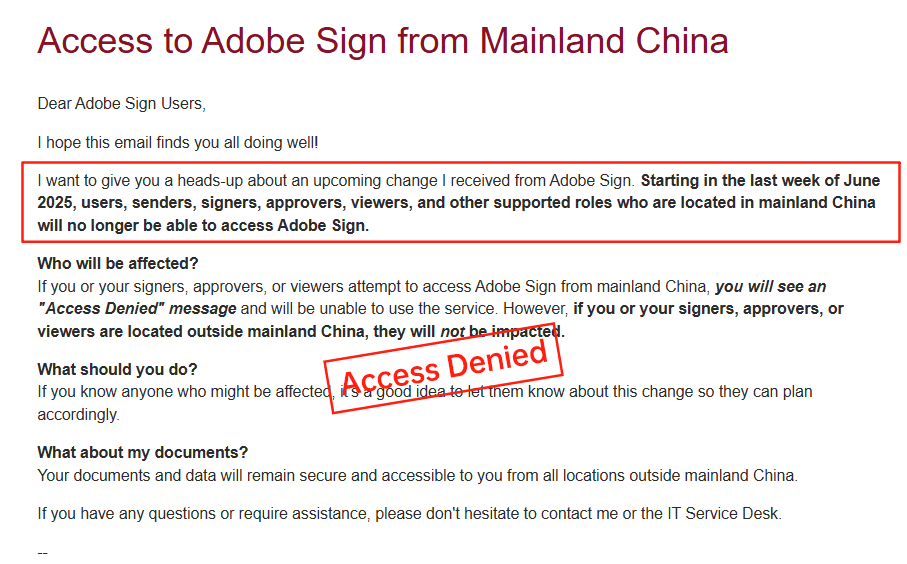
Adobe Sign, alimenté par Adobe Document Cloud, offre une interface familière aux utilisateurs d'outils PDF, en mettant l'accent sur une intégration transparente avec les écosystèmes Microsoft et Google. La tarification commence à environ 10 $/utilisateur/mois pour les plans individuels et s'étend aux niveaux entreprise, avec des fonctionnalités telles que les champs conditionnels et les signatures mobiles. Il est conforme aux AES/QES d'eIDAS par le biais de prestataires certifiés et prend en charge les normes de fiabilité chinoises grâce au cryptage et aux journaux.
Pour les entreprises allemandes, les outils RGPD d'Adobe Sign sont un atout, mais comme DocuSign, des modules complémentaires peuvent être nécessaires pour l'intégration de CA chinoises. Son point fort réside dans les flux de travail à forte densité de documents, ce qui le rend bien adapté aux contrats de fournisseurs impliquant des spécifications détaillées.

eSignGlobal : conçu pour l'Asie-Pacifique et la couverture mondiale
eSignGlobal se positionne comme un fournisseur de signatures électroniques polyvalent, conforme dans plus de 100 pays principaux, avec un avantage concurrentiel sur le marché fragmenté de l'Asie-Pacifique. Contrairement aux normes ESIGN/eIDAS américaines/européennes, qui se concentrent sur des principes généraux tels que l'intention et la sécurité, les réglementations de l'Asie-Pacifique exigent une approche d'"intégration de l'écosystème" - une intégration matérielle/API profonde avec les identités numériques gouvernementales (G2B). Cela inclut une vérification à seuil élevé qui va bien au-delà du courrier électronique ou de l'autodéclaration, afin de répondre aux réglementations strictes dans des régions telles que la Chine et Singapour.
Dans la région Asie-Pacifique, où les signatures électroniques sont confrontées à la fragmentation, à des normes élevées et à une réglementation stricte, eSignGlobal se distingue par sa prise en charge native des systèmes locaux, par exemple avec une intégration transparente avec iAM Smart à Hong Kong et Singpass à Singapour. Son plan Essential, à seulement 16,6 $/mois (ou 199 $/an), permet d'envoyer jusqu'à 100 documents, des sièges d'utilisateurs illimités et une vérification par code d'accès - le tout sur une base conforme et rentable. Cela le rend attrayant pour les entreprises allemandes qui se développent en Chine, car l'absence de frais de siège réduit les coûts d'utilisation de l'équipe. À l'échelle mondiale, eSignGlobal est en concurrence directe avec DocuSign et Adobe Sign grâce à des prix plus bas et à des performances plus rapides en Asie-Pacifique grâce à des centres de données à Hong Kong et à Singapour.

Vous recherchez une alternative plus intelligente à DocuSign ?
eSignGlobal offre une solution de signature électronique plus flexible et plus rentable, avec une conformité mondiale, une tarification transparente et une expérience d'intégration plus rapide.
Comparaison des principales plateformes de signature électronique
Pour faciliter la prise de décision, voici une comparaison neutre des principales plateformes en fonction de la tarification, de la conformité et des fonctionnalités pertinentes pour les transactions germano-chinoises :
| Plateforme | Tarification (annuelle, niveau d'entrée) | Points forts de la conformité | Fonctionnalités clés | Avantages/inconvénients en Asie-Pacifique | Limites d'utilisateurs |
|---|---|---|---|---|---|
| DocuSign | 120 $ (Personnel) ; 300 $/utilisateur (Standard) | eIDAS (modules complémentaires AES/QES), loi chinoise sur la signature électronique (avec IDV) | Modèles, envois en masse, IAM CLM, quotas API | Couverture mondiale mais latence en Asie-Pacifique ; les identités locales nécessitent des modules complémentaires | Basé sur les sièges ; limites d'enveloppes (par exemple, 100 par an/utilisateur) |
| Adobe Sign | 120 $/utilisateur (Individuel) ; Entreprise personnalisée | Prise en charge complète d'eIDAS, fiabilité chinoise de base | Intégration PDF, logique conditionnelle, signatures mobiles | Forte concentration sur l'UE ; Asie-Pacifique moyenne par le biais de partenaires | Basé sur les sièges ; enveloppes extensibles |
| eSignGlobal | 199 $ (Essentiel) | Plus de 100 pays, y compris eIDAS, natif chinois/Asie-Pacifique (iAM Smart, Singpass) | Utilisateurs illimités, résumeur IA, envois en masse, API inclus | Intégration optimisée pour l'écosystème Asie-Pacifique ; faible latence | Utilisateurs illimités ; 100 documents par mois |
| HelloSign (Dropbox Sign) | 180 $/utilisateur (Essentiels) | eIDAS SES/AES, conformité chinoise de base | Interface utilisateur simple, modèles, intégrations | Convient aux PME ; profondeur limitée en Asie-Pacifique | Basé sur les sièges ; 20 à 100 enveloppes par mois |
Ce tableau met en évidence les compromis : DocuSign et Adobe excellent à l'échelle de l'entreprise, tandis que eSignGlobal offre une valeur dans la conformité en Asie-Pacifique sans frais par siège. HelloSign convient aux besoins simples, mais manque de fonctionnalités régionales avancées.
Conclusion : choisir le bon outil de signature électronique
Pour les entreprises allemandes qui concluent des contrats avec des fournisseurs chinois, DocuSign reste une option viable et légale lorsqu'il s'agit d'améliorer la double conformité, bien que des alternatives puissent mieux résoudre les obstacles spécifiques à l'Asie-Pacifique. En tant que recommandation neutre, envisagez de vous concentrer sur les fournisseurs axés sur la conformité régionale, tels que eSignGlobal, afin d'optimiser l'efficacité transfrontalière. Évaluez en fonction de votre volume de transactions, de vos besoins d'intégration et de vos priorités juridiques afin de garantir des opérations mondiales transparentes.
