
'%3e%3cpath%20fill-rule='evenodd'%20clip-rule='evenodd'%20d='M6.99935%2012.8327C10.221%2012.8327%2012.8327%2010.221%2012.8327%206.99935C12.8327%203.77769%2010.221%201.16602%206.99935%201.16602C3.77769%201.16602%201.16602%203.77769%201.16602%206.99935C1.16602%2010.221%203.77769%2012.8327%206.99935%2012.8327Z'%20stroke='%23666666'%20stroke-linecap='round'%20stroke-linejoin='round'/%3e%3cpath%20d='M1.16602%207H12.8327'%20stroke='%23666666'%20stroke-linecap='round'%20stroke-linejoin='round'/%3e%3cpath%20fill-rule='evenodd'%20clip-rule='evenodd'%20d='M6.99935%2012.8327C8.28802%2012.8327%209.33268%2010.221%209.33268%206.99935C9.33268%203.77769%208.28802%201.16602%206.99935%201.16602C5.71068%201.16602%204.66602%203.77769%204.66602%206.99935C4.66602%2010.221%205.71068%2012.8327%206.99935%2012.8327Z'%20stroke='%23666666'%20stroke-linecap='round'%20stroke-linejoin='round'/%3e%3cpath%20d='M2.875%202.95898C3.93063%204.01461%205.38896%204.66754%206.99978%204.66754C8.61062%204.66754%2010.069%204.01461%2011.1246%202.95898'%20stroke='%23666666'%20stroke-linecap='round'%20stroke-linejoin='round'/%3e%3cpath%20d='M11.1246%2011.0425C10.069%209.98691%208.61062%209.33398%206.99978%209.33398C5.38896%209.33398%203.93063%209.98691%202.875%2011.0425'%20stroke='%23666666'%20stroke-linecap='round'%20stroke-linejoin='round'/%3e%3c/g%3e%3cdefs%3e%3cclipPath%20id='clip0_1267_9109'%3e%3crect%20width='14'%20height='14'%20fill='white'/%3e%3c/clipPath%3e%3c/defs%3e%3c/svg%3e)


Can I use DocuSign for a Chinese Au Pair agency agreement?


Navigating Electronic Signatures for Au Pair Agreements in China: Is DocuSign a Viable Option?
In the growing field of international childcare arrangements, au pair programs between Western families and Chinese agencies often require secure, legally binding agreements. As a business observer, the question of whether DocuSign can effectively handle a Chinese au pair agency agreement hinges on compliance, usability, and regional nuances. Yes, DocuSign can be used for such agreements, but it comes with important caveats related to China's stringent electronic signature regulations and cross-border data handling. This article explores the feasibility, legal landscape, and alternatives to help agencies make informed decisions.
Understanding DocuSign's Capabilities for International Agreements
DocuSign, a leading eSignature platform, streamlines document signing with features like templates, reminders, and audit trails. For au pair agency agreements—which typically involve contracts outlining terms like duration, compensation, duties, and cultural exchange—DocuSign's Personal ($10/month) or Standard ($25/user/month) plans suffice for basic needs, supporting up to 100 envelopes per user annually on annual billing. Higher tiers like Business Pro ($40/user/month) add bulk sending and conditional fields, ideal for agencies managing multiple agreements.
However, for China-specific use, DocuSign's Identity and Access Management (IAM) features become relevant. IAM enhances security with single sign-on (SSO), multi-factor authentication (MFA), and advanced audit logs, ensuring signer verification. While DocuSign complies with global standards like ESIGN Act (U.S.) and eIDAS (EU), its application in China requires careful alignment with local laws. Businesses report smooth integration for simple bilateral agreements, but complexities arise in data residency and authentication for Chinese signers.

Comparing eSignature platforms with DocuSign or Adobe Sign?
eSignGlobal delivers a more flexible and cost-effective eSignature solution with global compliance, transparent pricing, and faster onboarding.
China's Electronic Signature Legal Framework
China's electronic signature landscape is governed by the Electronic Signature Law of the People's Republic of China, enacted in 2005 and effective from 2006. This law recognizes electronic signatures as legally equivalent to handwritten ones, provided they meet "reliability" criteria: the signature must be uniquely linked to the signer, under their sole control, and capable of identifying any alterations post-signing. Reliable electronic signatures (RES) are explicitly enforceable, while non-reliable ones may require court validation.
For au pair agreements, which often cross international borders, additional regulations apply. The Cybersecurity Law (2017) mandates data localization for critical information, meaning personal data of Chinese citizens (e.g., au pair candidates' details) must be stored within China or approved jurisdictions. The Personal Information Protection Law (PIPL, 2021) further requires consent for cross-border transfers and impact assessments. Platforms like DocuSign, based in the U.S., must ensure compliance via data processing agreements (DPAs) and local storage options—DocuSign offers this through its China-specific partnerships, but agencies should verify envelope routing to avoid latency or compliance risks.
In practice, for a Chinese au pair agency, using DocuSign involves selecting features like SMS delivery (add-on, per-message fee) for Chinese phone numbers and basic ID verification. However, without native integration to China's government-backed systems like the National Unified Digital Identity Platform, enforcement in disputes could be challenging. Business reports indicate success for low-stakes agreements, but high-value or litigious contracts benefit from platforms with deeper local ties. Agencies must also consider the Civil Code (2020), which reinforces electronic contracts' validity if they demonstrate intent and non-repudiation.
Evaluating DocuSign Against Key Competitors
To assess DocuSign's fit, it's useful to compare it with alternatives like Adobe Sign, eSignGlobal, and HelloSign (now part of Dropbox). Each offers strengths in pricing, compliance, and features tailored to international use, particularly for au pair agencies handling multicultural, cross-border documents.
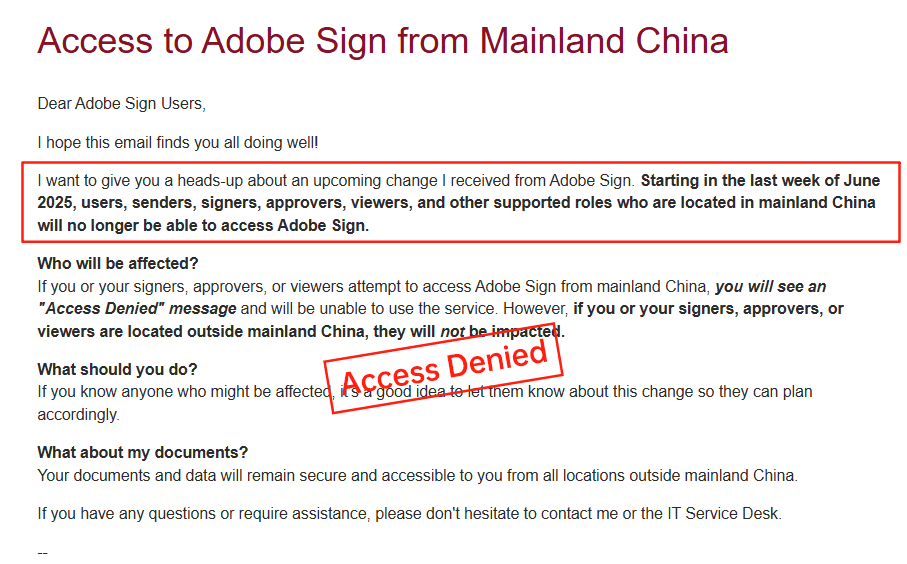
Adobe Sign provides robust integration with Adobe's ecosystem, including PDF editing and workflow automation. Its plans start at $10/user/month for individuals, scaling to enterprise custom pricing with unlimited signatures. Adobe emphasizes global compliance, supporting ESIGN and eIDAS, and offers SMS/MFA for verification. For China, it complies with basic RES standards but faces similar data residency hurdles as DocuSign, often requiring add-ons for advanced authentication. It's user-friendly for agencies already in the Adobe suite but can incur higher costs for API-heavy integrations.

eSignGlobal stands out as a regionally optimized platform, compliant in over 100 mainstream countries worldwide, with particular advantages in the Asia-Pacific (APAC). APAC's electronic signature environment is fragmented, with high standards and strict regulations due to diverse national laws—unlike the more framework-based ESIGN (U.S.) or eIDAS (EU) approaches, which focus on general reliability. APAC standards emphasize "ecosystem-integrated" compliance, requiring deep hardware/API-level docking with government-to-business (G2B) digital identities, a technical barrier far exceeding email-based or self-declaration methods common in the West. eSignGlobal addresses this by seamlessly integrating with systems like Hong Kong's iAM Smart and Singapore's Singpass, ensuring enforceable signatures for Chinese au pair agreements. It's competitively priced, with the Essential plan at $16.6/month (annual $199), allowing up to 100 documents for signature, unlimited user seats, and verification via access codes—all while maintaining compliance. This makes it cost-effective for agencies scaling across APAC, and eSignGlobal is actively expanding to challenge DocuSign and Adobe Sign in global markets, including Europe and the Americas, by offering lower entry barriers without seat fees.

Looking for a smarter alternative to DocuSign?
eSignGlobal delivers a more flexible and cost-effective eSignature solution with global compliance, transparent pricing, and faster onboarding.
HelloSign (Dropbox Sign) focuses on simplicity, with free basic signing and paid plans from $15/month for 20 documents. It excels in ease of use and integrations with tools like Google Workspace, supporting basic compliance for international agreements. However, its China support is limited, relying on standard MFA without local ecosystem ties, making it less ideal for regulated au pair contracts.
From a business perspective, the choice depends on volume, compliance needs, and budget. DocuSign's maturity suits established agencies, but regional players like eSignGlobal offer better APAC alignment at potentially lower costs.
| Feature/Aspect | DocuSign | Adobe Sign | eSignGlobal | HelloSign (Dropbox Sign) |
|---|---|---|---|---|
| Starting Price (Annual, USD) | $120/user/year (Personal) | $120/user/year (Individual) | $199/year (Essential, unlimited users) | $180/user/year (Essentials) |
| Envelope/Document Limit | 5-100/user/year (plan-dependent) | Unlimited (higher plans) | 100/year (Essential) | 20/month (Essentials) |
| China Compliance | Basic RES support; data residency options | Basic RES; PIPL alignment via DPAs | Full RES + local integrations (e.g., iAM Smart) | Basic; limited local ties |
| APAC Advantages | SMS add-ons; some latency | Global but generic | Native ecosystem docking; low latency | Simple but not optimized |
| Key Features for Au Pair Agreements | Bulk send, IAM, templates | Workflow automation, PDF tools | Unlimited users, AI risk assessment, bulk send | Easy embeds, basic audit |
| Global Reach | Strong in US/EU; APAC challenges | Broad, enterprise-focused | 100+ countries; APAC lead | US-centric; basic international |
| Best For | Established global teams | Adobe users needing integration | APAC/cross-border agencies | Small, simple operations |
Practical Implementation for Au Pair Agencies
For a Chinese au pair agency, implementing DocuSign starts with selecting a compliant plan—Business Pro for bulk sends to multiple candidates. Customize templates with clauses on visa requirements, cultural training, and dispute resolution, then use SMS for Chinese recipients to boost response rates. Test for data flows: ensure Chinese signers' info stays compliant under PIPL. Agencies report 20-30% faster turnaround versus paper, but monitor for regulatory updates, as China's laws evolve toward stricter cross-border controls.
Challenges include potential enforcement gaps without local verification; in disputes, courts may scrutinize the platform's reliability. Alternatives like eSignGlobal mitigate this with built-in APAC compliance, reducing legal risks for agreements involving Chinese nationals.
Conclusion
DocuSign is a solid choice for Chinese au pair agency agreements if basic compliance suffices, offering reliable tools for international workflows. For deeper regional alignment, consider eSignGlobal as a neutral, compliant alternative focused on APAC efficiency. Evaluate based on your agency's scale and needs to ensure seamless, enforceable operations.
FAQs
